
Last updated November 4, 2026
 Wrought iron
 Wood & steel frame
 Farm & ranch
 Sliding driveway gates
 LiftMaster operators
Free on-site gate assessment - hinges, posts, and your LiftMaster or Nice gate operator checked before anything is quoted
The assessment is free and the quote is the invoice.
Get your free estimateDIY vs Professional Gate Repair: The Evergreen Homeowner’s Decision Guide
Most Evergreen homeowners don’t fail at DIY gate repair because they lack mechanical skill. They fail because they can’t tell the difference between an adjustment and a calibration. Adjusting a gate’s travel limit so it opens a few more inches is a reasonable weekend task. Adjusting entrapment protection force settings without a calibration tool is a liability, and both options live on the same menu screen of a modern operator. This guide gives you a clear decision framework based on repair type, not confidence level. By the end, you’ll know exactly which gate problems are genuinely safe to handle yourself and which ones call for a specialist.
Quick Answer
DIY gate repair makes sense for lubrication, remote battery replacement, manual release operation, and clearing track debris. Professional gate repair is necessary for safety loop calibration, force limit adjustment on entrapment zones, control board replacement, and ground fault diagnosis. In Evergreen, the decision hinges on one question: does the repair touch a safety-critical component under UL 325 standards? If it does, hire a professional. If it doesn’t, a careful homeowner with basic tools can usually handle it.
Styles & brands we work with
- Wrought iron
- Wood & steel frame
- Farm & ranch
- Sliding driveway gates
- LiftMaster operators
Table of Contents
- The Real Line Between DIY and Professional Gate Repair
- What’s Actually DIY-Safe: The Complete List
- What Requires a Professional: No Exceptions
- UL 325 and Why It Changes the Calculation
- California Liability: What a Botched DIY Repair Actually Costs
- Parts Sourcing Reality for Evergreen Homeowners
- The Cost Calculation That Actually Matters
- Step-by-Step: How to Decide in 5 Minutes
The Real Line Between DIY and Professional Gate Repair
Here’s what most guides won’t tell you. The divide between DIY and professional gate repair isn’t about how handy you are. It’s about component category. A gate system has three layers: mechanical hardware, electrical controls, and safety systems. The first layer is forgiving. The second demands diagnostic equipment. The third is governed by federal standards that don’t care how confident you felt when you opened the panel.
At Atlas Gate Repair, we see the same pattern in Evergreen: a homeowner fixes something mechanical, feels good about it, then tries something electrical and creates a problem that costs more than the original repair would have. Our repair-first approach means we tell you honestly whether a fix makes sense or a replacement does. But the single most useful thing we can tell you is where the line sits.
Mechanical adjustments change how the gate moves. Electrical adjustments change how the gate thinks. Safety adjustments change what the gate does when something is in the way. Once you frame it that way, most decisions become obvious.
What’s Actually DIY-Safe: The Complete List
We’ll be direct. There are exactly four areas where a competent Evergreen homeowner should feel comfortable working on a gate. Everything beyond this list lands in the professional column, and we’ll explain why each one matters.
- Hinge and track lubrication. A gate that groans or moves stiffly usually needs lubricant at the hinge points and along the track. Use a silicone-based lubricant, not grease, which collects grit from Evergreen’s dry, dusty air. Wipe everything down first, apply sparingly, and work the gate manually to distribute it.
- Remote battery replacement. If the gate works from the keypad but not the remote, the remote battery is the likely culprit. Pop the case, note the battery size, and replace it. No tools beyond a small screwdriver. This is true for every major brand we work with, including FAAC, BFT, and Linear systems.
- Manual release operation. Every automatic gate has a manual release mechanism, usually a keyed lock or pull handle near the operator. Knowing how it works matters in a power outage. Operating it is safe, and so is practicing it once. You’re not adjusting anything; you’re disengaging the operator so the gate moves freely by hand.
- Basic track debris clearing. Slide gates in Evergreen collect leaves, twigs, and gravel in the track. If the gate starts slowing down or reversing unexpectedly, clear the track first. Use a broom or a leaf blower, not a pressure washer. Water forces debris deeper into the rollers and bearings.
Notice what’s missing from this list. Nothing involving springs, cables under tension, motors, circuit boards, sensors, or limit settings. That’s intentional. The moment a repair touches anything that stores energy or controls entrapment protection, it belongs with a gate specialist.
What Requires a Professional: No Exceptions
These repairs require a professional regardless of homeowner skill. This isn’t gatekeeping. It’s the same logic as electrical work: the danger isn’t visible until it’s too late. A gate operator has capacitors that hold a charge even after the power is off, and the motor itself can move hundreds of pounds with enough force to crush a person.
- Safety loop calibration. Safety loops detect vehicles and prevent the gate from closing on them. Calibrating one requires setting the detection frequency and sensitivity precisely. A loop set too sensitive triggers false reversals. Set too low, it fails to detect a child on a bicycle. There’s no consumer-level tool that measures whether the setting is correct.
- Force limit adjustment on entrapment zones. This is the big one. The force limit determines how much resistance the gate encounters before it reverses. Too much force, and the gate can injure someone. Too little, and the gate won’t close against a stiff breeze. Testing it properly means using a force gauge in multiple positions along the gate’s travel, and that’s not something a homeowner has in the garage.
- Control board replacement. The control board is the brain of the system. Replacing one means matching the board revision to the operator model, transferring settings correctly, and often reprogramming remotes and keypads. A wiring mistake here can fry the new board or create erratic behavior that’s hard to trace later. We work across systems like Viking and BFT, and even we verify every connection before powering up.
- Ground fault diagnosis. A ground fault means electricity is leaking to somewhere it shouldn’t go, often through a damaged wire or failed component. Chasing one requires a multimeter, an understanding of how the circuit should read, and the patience to isolate each segment. A homeowner who guesses here risks a shock or a fire, and in Evergreen’s dry conditions, the electrical risk is real.
If your gate problem falls into any of these categories, the smart move is to call a professional who works on electric gate repair every day. The diagnostic alone usually costs less than the secondary damage from an attempted fix.
UL 325 and Why It Changes the Calculation
UL 325 is the federal safety standard for automatic gate operators. It defines the entrapment protection requirements that every manufactured gate system must meet. The key thing to understand is that UL 325 isn’t a suggestion that applies to the factory. It’s a standard that applies to the installed system, which means the person who installs or adjusts the system is the person responsible for whether it still meets the standard after the work is done.
That’s where the DIY calculation changes. When a homeowner adjusts force limits or bypasses a sensor to stop a gate from reversing, the gate may work. But it may no longer meet UL 325’s entrapment protection requirements. And if someone is injured by that gate, the liability question doesn’t begin with the operator manufacturer. It begins with the person who last modified the system.
Our technicians at Atlas Gate Repair understand this because it’s the core of what makes electric gate work different from mechanical gate work. A hinge that squeaks doesn’t have a safety standard attached to it. A force limit setting does. That’s the line.
California Liability: What a Botched DIY Repair Actually Costs
We don’t need to give you a legal lecture. But in Evergreen, as anywhere in California, property owners have a legal duty to maintain their premises in a reasonably safe condition. A gate that doesn’t meet UL 325 entrapment standards is a hazard, and if someone gets hurt, the homeowner faces personal injury exposure. That’s not a scare tactic. It’s the same logic as a broken step or an unpermitted deck.
The practical version is this: insurance companies ask questions after an injury. If the answer to “Who adjusted the gate’s safety settings?” is “I did, myself, with a YouTube video,” the claim gets complicated. If the answer is “A licensed company that works on these systems professionally,” the liability sits with the professional’s insurance and expertise.
This is why we draw the line where we do. Hinge lubrication doesn’t create liability. Disabling a photo eye sensor so the gate stops beeping does. And the homeowner who removes or bypasses a safety feature because it was annoying has converted a nuisance into a legal exposure. The repair that takes five minutes to make the beeping stop can become the thing a lawyer asks about for years.
Parts Sourcing Reality for Evergreen Homeowners
Here’s a practical hurdle most DIY guides skip entirely. Not every gate part is available to a retail buyer. Some components are sold through dealer networks or professional supply channels, and that’s a signal worth paying attention to.
OEM parts for brands like FAAC, BFT, Linear, and Viking fall into two buckets. Consumables and user-serviceable parts, like remotes and keypads, are generally available online. But control boards, safety edge sensors, and certain operator components often require a dealer account to purchase. When you see a part listed as “dealer only” or “installer only,” that’s not a markup conspiracy. It’s the manufacturer protecting their safety compliance chain. They want trained professionals installing safety-critical components, not well-meaning homeowners.
For an Evergreen homeowner, this changes the math on a lot of repairs. If you can’t buy the right part at retail, you’re already looking at either a substitute part that may not be compatible or a used part of uncertain condition. Neither of those is a good foundation for a gate that has to block traffic and keep people safe.
Our team works with these brands daily in Evergreen. We know which parts are worth repairing and which ones signal that replacement is the smarter path. When we tell a customer that a part isn’t worth buying again, it’s because we’ve seen how it fails over time in this climate. That kind of judgment only comes from working on gates specifically, not gate repair as a side business.
The Cost Calculation That Actually Matters
Most DIY-vs-professional comparisons frame the question as “DIY costs $40 in parts, professional costs $400.” That’s a false frame. The real comparison is “DIY attempt costs $40 in parts” versus “professional repair costs $400” only when the DIY attempt works perfectly the first time. And on the repairs that matter, it often doesn’t.
The cost calculation that actually matters is DIY-attempt cost versus professional cost when the attempt creates a secondary repair need. Mis-wire a control board and the replacement cost goes from a board swap to a board swap plus wiring harness repair plus possibly a new transformer. Adjust a force limit too high and the gate slams into the end stop, bending a bracket or cracking a wheel. That $40 in parts becomes a $700 repair, and you’ve spent a Saturday to get there.
For Evergreen homeowners, the climate adds a layer. Dry, dusty air is hard on gate components, but it also means that mud and corrosion are less of a factor than in other parts of the country. The primary failure modes here are electrical component wear from heat cycling and mechanical wear from dust infiltration. Those are exactly the failure modes where misdiagnosis is expensive. A homeowner who replaces a part that wasn’t bad hasn’t fixed anything and is now out the cost of the part.
Step-by-Step: How to Decide in 5 Minutes
If you’re standing in front of a misbehaving gate in Evergreen right now, here’s how to decide what to do. This works for any brand, any gate style, any problem.
- Is anyone’s safety at risk at this moment? If the gate moves when it shouldn’t, doesn’t stop when it should, or operates with a keypad code you never set, stop using it. Lock it in manual mode and call a professional. Don’t keep testing it.
- Find the symptom. Does the gate move but make noise? That’s mechanical, likely a candidate for DIY lubrication. Does it not respond to any input? That’s electrical. Does it behave erratically, reversing without reason or stopping mid-cycle? That’s a safety system or logic issue.
- Check the simplest explanation first. Remote dead? Replace the battery. Track full of debris? Clear it. Keypad unresponsive? Check the breaker. Half of all gate service calls in Evergreen resolve with one of these, and they’re all homeowner-safe.
- If the simple explanation isn’t it, stop guessing. Once you’ve ruled out the four DIY-safe items on our list, every remaining possibility touches wiring, sensors, motor components, or safety settings. That’s the professional column.
- Ask the parts question. If you know what part you need, search for it. If it’s dealer-only, that’s your answer: call a professional. The manufacturer has already decided this repair shouldn’t be a DIY project.
- Calculate the real cost. Before you order a part and start working, write down what the professional repair would cost and what a second repair would cost if your attempt doesn’t work. If the two are close, hire the professional and keep your weekend.
Common Mistakes to Avoid
- Bypassing a sensor to make the gate stop reversing. That reversing behavior is the entrapment protection doing its job. Disabling it fixes the symptom and creates a hazard. A professional diagnoses why the sensor is tripping, not whether to disconnect it.
- Using the wrong lubricant. WD-40 isn’t a lubricant for gate hinges. It cleans, then dries out, leaving bare metal. In Evergreen’s dusty air, a dry hinge wears fast. Use silicone spray or white lithium grease.
- Adjusting limit settings to compensate for a sagging gate. If the gate sags, the fix is in the hinge or wheel assembly, not the operator programming. Crank-king the limit settings masks the problem and stresses the motor.
- Replacing the remote when the receiver is the problem. If a new battery doesn’t fix the remote, the next step isn’t necessarily a new remote. Test whether the keypad still works. If it does, the issue may be the receiver on the control board, not the remote itself.
- Water and electronics don’t mix. Pressure washing a gate with integrated sensors and a keypad is a quick way to fry components. If you’re cleaning the gate, keep water away from the control box, keypad, and sensor housings.
- Misdiagnosing a power issue. A gate that works sometimes and not others might have a dying capacitor, a failing transformer, or a loose connection. Guessing at these components without testing equipment rarely ends well.
See the difference
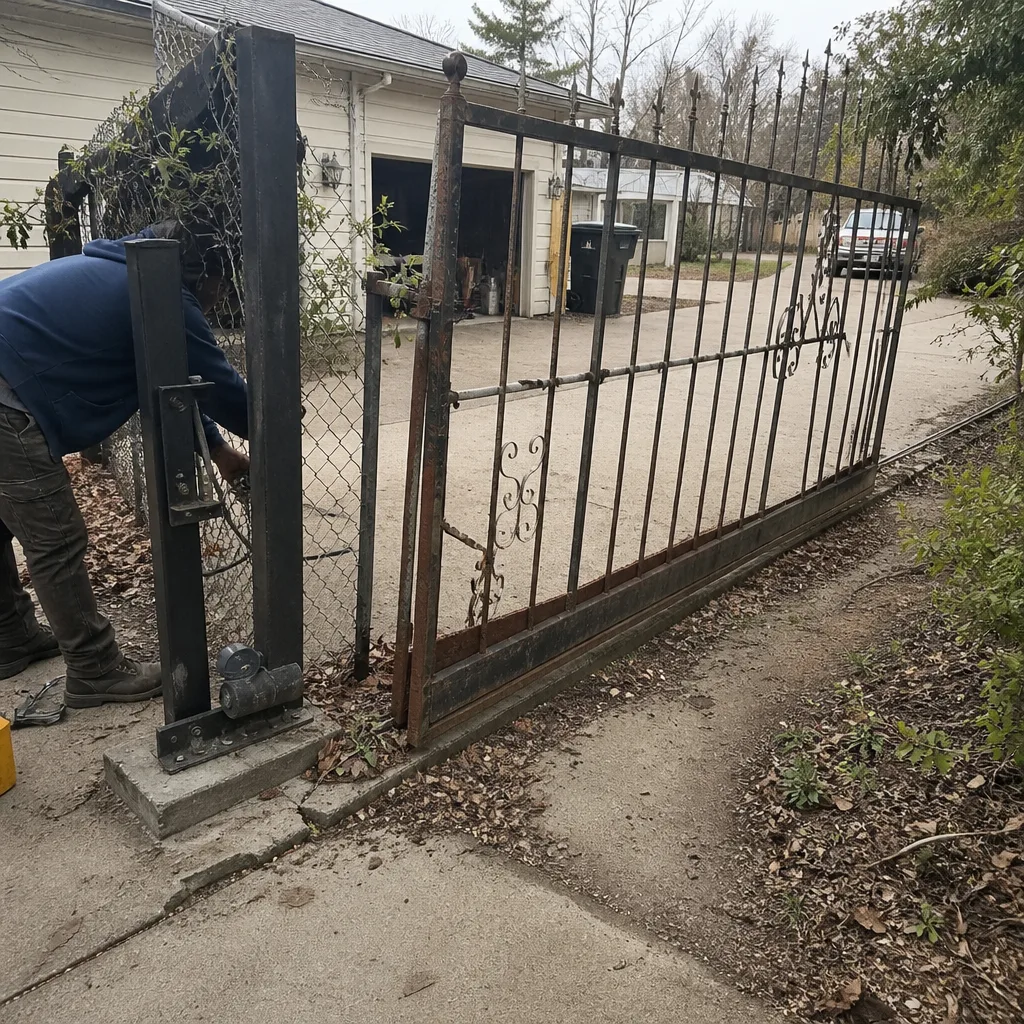 Before
 After
 Before
 After
 Before
 After
When to Call a Professional
Call a professional when the gate reverses without reason, fails to close, moves with unusual force, sparks, smells like burning, or trips the breaker repeatedly. Call when the keypad or remote stops working and a battery swap doesn’t fix it. Call when the gate has hit something, even if it seems fine afterward, because impact damage often shows up later in the operator or track. Call when you’ve already replaced a part and the problem persists. And call when you’re looking at a safety sensor or force setting and you’re not sure what it does. Atlas Gate Repair offers free estimates in Evergreen. Call (833) 589-9356. We answer 24/7. Fast dispatch from 7am to 7pm.
Frequently Asked Questions
Yes, if the task is lubrication, remote battery replacement, manual release operation, or clearing track debris. No, if the task involves wiring, sensors, force settings, control boards, or anything related to entrapment protection. If you’re unsure, call a professional. The wrong fix on a safety component is worse than no fix at all.
The most common gate repair in Evergreen is a sensor or safety edge problem, usually caused by dust buildup, heat cycling, or a broken wire in the track. These systems sit outdoors in dry, dusty air, and the components degrade even when the gate itself looks fine. Most sensor problems are diagnosed with testing equipment, not by looking at the component.
Professional gate repair costs vary depending on the component, the brand, and whether parts need to be ordered. Every job is priced by written estimate before work starts, so there’s no surprise. Atlas Gate Repair offers free estimates in Evergreen. Call (833) 589-9356 for an exact quote based on your gate and the problem.
A gate that won’t stay closed usually has a problem with the safety loop, the safety edge, or the force limit settings. These are the components that tell the gate when to reverse. If any of them is mis-calibrated or failing, the gate treats every closing as if something is in the way. Diagnosing which one is the culprit requires testing equipment, which is why this is a professional repair.
Most repairs to an existing gate don’t require a permit. Replacing a major component like the operator or making significant structural changes might, depending on the local requirements. Your city’s building department is the authority on this, so ask them before starting any large project. A professional gate company can also advise you on what’s typical for Evergreen.
We answer 24/7. Fast dispatch from 7am to 7pm, Sunday through Friday. Many repairs in Evergreen are completed in a single visit. Call (833) 589-9356 and we’ll let you know what we can do when we understand the problem.
The Bottom Line
The DIY-vs-professional gate repair decision comes down to the component, not your confidence. Hinges, remotes, manual releases, and track debris are homeowner territory. Everything else, especially anything that touches UL 325 safety systems, belongs with a specialist. In Evergreen, where dry, dusty conditions wear on gate electronics, a misdiagnosis gets expensive quickly. The smart homeowner handles the simple maintenance items, recognizes the professional-only repairs, and calls before a small problem becomes a big one. Atlas Gate Repair has worked on Evergreen gates since 2017, across every major brand from Viking to BFT. When the repair matters, call (833) 589-9356.
Written by the team at Atlas Gate Repair, serving Evergreen since 2017.